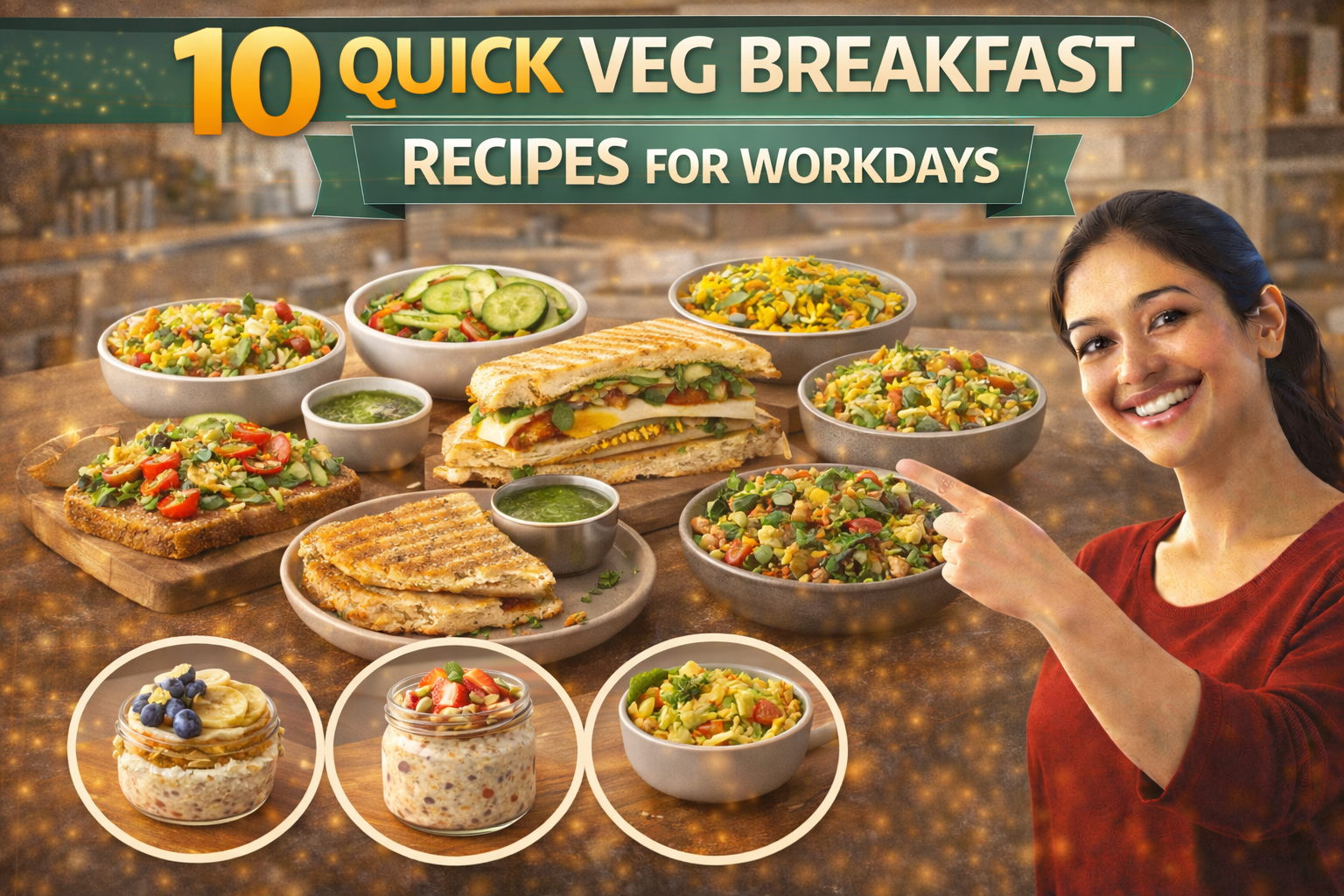
10 Quick Veg Breakfast Recipes for Workdays : The workday morning presents a unique culinary challenge. The clock ticks mercilessly toward your commute, your inbox already filling with demands you haven’t yet seen, and somewhere in this chaos, you need to fuel your body for the hours ahead. The temptation to skip breakfast entirely or grab something processed and unsatisfying is real and understandable. But it comes with consequences—the mid-morning energy crash, the desperate reach for unhealthy snacks, the difficulty concentrating when your stomach is growling.
The recipes that follow are designed specifically for the working professional who values both their sleep and their health. They acknowledge that you don’t have forty-five minutes to craft an elaborate meal before heading out the door. They respect that your energy in the morning is limited and that every minute of sleep matters. Each recipe can be prepared in fifteen minutes or less, using ingredients that require minimal preparation and equipment that won’t create a mountain of dishes to tackle when you return home exhausted.
These are not complicated, multi-step productions. They are straightforward, reliable, delicious breakfasts that have sustained working people for generations, long before the concept of “meal prep” entered our vocabulary. From the five-minute simplicity of spiced scrambled paneer to the make-ahead convenience of vegetable poha that tastes freshly made even when reheated, these ten recipes will transform your workday mornings from a source of stress into a moment of simple, nourishing pleasure.
Read More : 10 High-Protein Breakfast Ideas to Start Your Day
12 Easy Breakfast Recipes Without Eggs
10 Traditional Indian Breakfasts You Can Make Fast
8 Healthy Breakfast Recipes for Weight Loss Diet
10 Quick Paneer Breakfast Recipes for Protein Boost
1. Masala Omelette: The Five-Minute Classic
For those who include eggs in their diet, the masala omelette represents the perfect workday breakfast. It cooks in the time it takes to brew your coffee, requires only a single pan, and delivers protein that will keep you full through the most demanding morning meetings .
The technique matters more than most people realize. Begin by cracking two or three eggs into a bowl. Add a tablespoon of water—this seemingly small addition creates steam during cooking, resulting in an omelette that is fluffy and tender rather than dense and rubbery. Whisk vigorously until the yolks and whites are completely combined and the mixture is slightly frothy on top. This thorough incorporation of air is the secret to a light texture .
Now add your flavorings. Finely chop one small onion, one green chili if you enjoy heat, and a small handful of fresh coriander. These aromatics should be cut small enough that they distribute evenly throughout the omelette rather than clumping in one section. Add them to the beaten eggs along with salt and a pinch of turmeric for color. Some cooks add a chopped tomato, though if you do, remove the seeds first to prevent excess moisture that can make the omelette watery .
Heat a non-stick pan over medium flame and add a small amount of oil or butter—just enough to coat the surface. When the pan is hot, pour in the egg mixture and tilt to spread it evenly. Let it cook undisturbed for about two minutes, until the edges are set and the bottom is golden. If you’re adding cheese, scatter it over one half now. Fold the other half over and cook for another thirty seconds. Slide onto a plate and you’re eating within five minutes of walking into the kitchen. For the ultimate workday efficiency, eat it between two slices of toast as a sandwich you can hold in one hand while gathering your things with the other.
2. Paneer Bhurji: The Vegetarian Protein Powerhouse
Paneer bhurji, the spiced scrambled Indian cottage cheese, is to vegetarian professionals what scrambled eggs are to everyone else—a protein-dense, quick-cooking, endlessly satisfying breakfast that comes together in minutes and keeps you full for hours .
The preparation begins with crumbling the paneer. Take 100 to 150 grams of fresh paneer and crumble it with your fingers into irregular pieces. The irregularity is intentional; hand-crumbling creates varied textures that machine-grating cannot replicate, with some larger pieces providing creamy pockets and smaller pieces absorbing the spices more thoroughly .
Heat a small pan with a tablespoon of oil or ghee. Add half a teaspoon of cumin seeds and let them sizzle for a few seconds until fragrant. Add a finely chopped green chili and a teaspoon of finely grated ginger—these aromatics form the flavor base. Then add half a finely chopped onion and sauté until it turns translucent and begins to brown at the edges. This browning develops sweetness that balances the spices .
Now add a finely chopped tomato and cook until it softens and begins to break down. The turmeric powder goes in at this stage, along with a pinch of red chili powder if you desire heat, and salt to taste. Cook the masala for another minute until the oil begins to separate slightly around the edges. Finally, add the crumbled paneer and stir gently to coat it with the spiced mixture. Cook for only two to three minutes—any longer and the paneer will become rubbery and dry. Finish with a generous handful of fresh coriander and a squeeze of lemon juice. Serve with toast, stuff into a sandwich, or eat it straight from the pan. Total time: twelve minutes, most of which is passive cooking while you prepare your coffee or pack your bag.
3. Vegetable Poha: The Make-Ahead Marvel
Poha, or flattened rice, is arguably the most workday-friendly breakfast in the Indian repertoire. It requires minimal cooking, uses ingredients that keep indefinitely in your pantry, and can be made in batches that reheat beautifully for those mornings when you have no time to cook at all .
For the freshest preparation, start with thick poha. Place half a cup in a strainer and rinse it briefly under running water—just until it softens, which takes about thirty seconds. Then set it aside to drain completely. Over-rinsing leads to mushy poha, so this step requires a light touch and attention .
While the poha drains, heat a pan with oil. Add half a teaspoon of mustard seeds and wait for them to splutter. Add a few curry leaves if you have them—they’re worth seeking out for the authentic flavor they provide. Add a chopped green chili and a handful of peanuts, sautéing until the peanuts begin to color. Add half a finely chopped onion and cook until translucent, then add a pinch of turmeric powder for color and its anti-inflammatory properties .
Now add any vegetables you have on hand—finely chopped carrot, peas, or bell peppers all work beautifully. Sauté for two minutes, then add the soaked and drained poha along with salt to taste. Stir gently to combine, cover the pan, and let it steam on low heat for two to three minutes. Turn off the heat and let it rest for another minute. Finish with fresh coriander and a squeeze of lemon. For make-ahead convenience, double or triple the recipe and portion the finished poha into containers. It reheats perfectly in the microwave for a breakfast that requires zero morning effort beyond pressing a button.
4. Besan Chilla: The Savory Pancake Solution
Besan chilla, or savory gram flour pancakes, represent one of the most protein-dense, quick-cooking breakfasts available to the vegetarian professional. Gram flour (besan) is inexpensive, keeps forever in your pantry, and transforms into a satisfying meal in the time it takes to get ready for work .
The batter requires no resting or fermentation—just mixing. In a bowl, combine half a cup of besan with water, whisking to form a smooth, lump-free batter. The consistency should be similar to that of pancake batter—pourable but not watery. To this base, add finely chopped onion, tomato, and green chili. These vegetables add flavor and texture, but the chilla works perfectly well without them if you’re in a hurry. Add salt, a pinch of turmeric, and a sprinkle of cumin seeds or ajwain (carom seeds) which aids digestion .
For an extra protein boost and to use up leftovers, a tablespoon of finely chopped spinach or grated carrot adds nutrients without significantly altering the flavor. Some cooks add a spoonful of finely chopped bell pepper or even leftover cooked vegetables from last night’s dinner. The chilla is endlessly forgiving and adaptable .
Heat a non-stick pan and grease it lightly with oil. Pour a ladleful of batter and spread it gently into a circle—besan batter won’t spread as easily as wheat flour batter, so coax it gently with the back of your ladle. Cook until the bottom is golden and the edges begin to lift, then flip carefully and cook the other side. These chillas are surprisingly filling, thanks to the protein and fiber in the gram flour. Make two or three, stack them, and you have a portable breakfast that can be eaten on the go or at your desk. Total time: fifteen minutes for a batch.
5. Masala Oats: The Modern Professional’s Choice
For the health-conscious professional who wants the comfort of a warm breakfast with the nutritional profile of whole grains, masala oats delivers. This desi-inspired take on oatmeal transforms the humble rolled oat into a spiced, savory breakfast that bears no resemblance to the bland porridge you might remember from childhood .
The key is treating oats like you would treat poha or upma—as a blank canvas for Indian flavors. Start with rolled oats, not instant oats, which are more processed and have a higher glycemic impact. In a pan, heat a tablespoon of oil. Add half a teaspoon of mustard seeds and let them splutter. Add a few curry leaves, a chopped green chili, and half a finely chopped onion. Sauté until the onion softens .
Now add vegetables—finely chopped carrot, peas, capsicum, or whatever you have in your refrigerator drawer. Sauté for two minutes. Add a pinch of turmeric, a pinch of red chili powder if you like heat, and salt to taste. Stir to coat the vegetables with the spices. Add half a cup of rolled oats and stir for a minute to lightly toast them, which enhances their nutty flavor .
Pour in one cup of water and bring to a boil. Reduce the heat and simmer for three to five minutes, until the oats are cooked and have absorbed most of the liquid. The consistency should be porridge-like but not too thick—add a little more water if needed. Finish with fresh coriander and a squeeze of lemon. This breakfast comes together in ten minutes, costs very little, and delivers sustained energy from the complex carbohydrates and fiber in the oats. For variety, top with a spoonful of peanuts for crunch or a dollop of yogurt for creaminess.
6. Vegetable Upma: The South Indian Workday Staple
Upma, the savory semolina porridge beloved across South India, has sustained generations of working people through long mornings. It cooks quickly, uses pantry staples, and can be endlessly varied based on what vegetables you have available .
The secret to perfect upma lies in the roasting of the semolina. Measure half a cup of fine semolina (suji or rava) and dry roast it in a pan over medium heat, stirring constantly, until it becomes fragrant and just begins to change color. This step takes about three to four minutes and is absolutely crucial—insufficient roasting leaves the upma with a raw, pasty taste, while over-roasting makes it dark and bitter. Remove the roasted semolina from the pan and set aside .
In the same pan, heat a tablespoon of oil. Add half a teaspoon of mustard seeds and wait for them to splutter. Add a teaspoon of chana dal and a teaspoon of urad dal if you have them—these add texture and protein—and sauté until they begin to color. Add a few curry leaves, a chopped green chili, and a one-inch piece of ginger, finely chopped. Add half a finely chopped onion and sauté until soft .
Now add your vegetables. Finely chopped carrot, peas, chopped beans, or capsicum all work beautifully. Sauté for two minutes, then add one and a half cups of water and salt to taste. Bring the water to a rolling boil. Reduce the heat to low and slowly add the roasted semolina in a thin stream, stirring continuously with your other hand to prevent lumps from forming. This simultaneous addition and stirring is the technique that separates perfect upma from lumpy disappointment .
Stir until all the water is absorbed and the upma comes together into a cohesive mass—this takes about two to three minutes. Cover the pan and let it rest on low heat for another two minutes. Turn off the heat and let it rest for five minutes before serving. Fluff with a fork, garnish with fresh coriander and a squeeze of lemon, and your breakfast is ready. Total time: about fifteen minutes, most of which is hands-off while water boils or the upma rests.
7. Methi Thepla: The Travel-Ready Breakfast
For professionals who eat breakfast at their desk, on their commute, or anywhere other than their kitchen table, methi thepla is a revelation. These spiced flatbreads from Gujarat are designed to travel well, staying soft and flavorful for hours without refrigeration. Make a batch on Sunday, and you have breakfast ready for the entire workweek .
The dough comes together quickly. In a large bowl, combine two cups of whole wheat flour with half a cup of finely chopped fresh fenugreek leaves (methi). If fresh methi isn’t available, use a tablespoon of kasuri methi (dried fenugreek leaves) crushed between your palms. Add half a teaspoon of turmeric, half a teaspoon of red chili powder, half a teaspoon of cumin seeds, and salt to taste. For authentic flavor, add a teaspoon of sugar and a tablespoon of oil. Mix everything with your fingers, rubbing the oil into the flour until the mixture resembles breadcrumbs .
Now add water gradually and knead into a firm, smooth dough. The dough should be slightly firmer than chapati dough, as the methi releases moisture during resting. Cover the dough and let it rest for at least fifteen minutes—this rest is essential for developing elasticity and making the rolling easier .
When you’re ready to cook, divide the dough into small balls. Roll each ball into a thin circle, using dry flour as needed to prevent sticking. Heat a tawa or flat pan and cook each thepla on both sides until golden brown spots appear, brushing with a little oil or ghee as it cooks. The theplas will puff slightly and develop a beautiful aroma. Stack them and wrap in a clean kitchen towel to keep them soft. In the morning, simply grab a thepla—it needs no reheating, though a few seconds in the microwave or on a hot pan improves it. Eat it plain, with yogurt, with pickle, or wrapped around leftover vegetables. It’s the ultimate workday breakfast for those who need to eat on the move.
8. Moong Dal Chilla: The High-Protein Option
For those seeking an even higher protein alternative to besan chilla, moong dal chilla delivers. Made from husked and split green gram (moong dal), these savory pancakes pack significantly more protein than their gram flour cousins while remaining light and easily digestible .
The preparation requires a small amount of foresight but minimal morning effort. The night before, rinse half a cup of moong dal thoroughly and soak it in water. In the morning, drain the soaked dal and transfer it to a blender. Add a small piece of ginger, a green chili, a pinch of salt, and just enough water to facilitate blending—about two to three tablespoons. Grind to a smooth, fluffy batter. The batter should be of pouring consistency, slightly thicker than dosa batter but thinner than pancake batter .
Pour the batter into a bowl and stir in finely chopped onions, tomatoes, fresh coriander, and a sprinkle of cumin seeds. If you have leftover vegetables, this is the place to use them—grated carrots, finely chopped spinach, or bell peppers all add nutrition and flavor. The batter can be thinned with a little water if it becomes too thick after standing .
Heat a non-stick pan and grease it lightly with oil. Pour a ladleful of batter and spread it gently into a circle. Cook until the bottom is golden and the edges begin to lift, then flip carefully—these chillas are more delicate than those made with besan, so a thin, flexible spatula helps. Cook the other side until done. Serve immediately with mint chutney, or stack them for later. These chillas are exceptionally filling, with the protein from the moong dal keeping hunger at bay for hours. Total morning time: about fifteen minutes, assuming the dal was soaked overnight.
9. Bread Pakora: The Indulgent Weekend-Transfer Breakfast
Sometimes a workday calls for something more indulgent, something that feels like a treat while still being quick enough for a weekday morning. Bread pakora fits this brief perfectly—it’s essentially a savory French toast made Indian-style, with spiced gram flour batter coating bread slices that are then pan-fried until crisp .
The batter is the key. In a shallow bowl, whisk together half a cup of besan with water to form a smooth batter with the consistency of thick cream. It should be thick enough to coat the bread generously but not so thick that it becomes pasty. Add a finely chopped green chili, a pinch of turmeric, a pinch of red chili powder, a sprinkle of cumin seeds, and salt to taste. Some cooks add a pinch of ajwain (carom seeds) for its digestive properties and distinctive flavor .
Take two slices of bread—white, brown, or whole wheat all work. Sandwich them together with a little green chutney if you have it, or simply leave them plain. Heat a non-stick pan or tawa with a generous amount of oil—enough to shallow fry. Dip each sandwich into the batter, turning to coat both sides completely, and let the excess drip off. Place the battered bread onto the hot pan and cook until golden brown and crisp on one side, then flip and cook the other side .
The result is a crispy, spicy, satisfying breakfast that comes together in about ten minutes. Serve with ketchup or more green chutney, and perhaps a cup of strong tea to complete the experience. While bread pakora feels indulgent, the besan coating adds protein and fiber that make it more substantial than plain toast. For a slightly healthier version, use whole wheat bread and minimal oil, cooking until just crisp rather than deep-fried.
10. Vegetable Sandwich: The No-Cook Workday Hero
For the ultimate quick workday breakfast, nothing beats a well-made vegetable sandwich. It requires no cooking whatsoever, can be assembled in the time it takes to gather your work things, and travels perfectly to be eaten at your desk or on your commute .
The foundation is good bread. Whole grain or multigrain bread provides more sustained energy than white bread, but any bread works. Toast it if you have time and want the texture contrast; leave it untoasted if you’re in a hurry. The spread matters—butter is traditional and delicious, but cream cheese, hummus, or even thinned yogurt with mint all work beautifully .
Now build your layers. Sliced cucumber adds refreshing crunch. Sliced tomato provides juiciness and vitamin C—sprinkle the tomato slices with a little salt and pepper to enhance their flavor. Sliced onion adds sharpness; if raw onion is too intense for morning, soak the slices in cold water for a few minutes to mellow their bite. If you have cheese, a slice adds protein and richness. For extra flavor, spread green chutney on one slice of bread and sweet chutney on the other, creating the classic Indian sandwich shop combination .
Press the sandwich together firmly, cut it in half, and wrap it in parchment paper or foil for easy transport. Pack it in your bag with an apple or a small yogurt cup, and you have a complete breakfast that requires zero morning time beyond the few minutes of assembly. The beauty of this approach is its flexibility—use whatever vegetables you have, whatever spread is open, whatever bread is available. The sandwich adapts to your pantry rather than requiring special ingredients.
| Breakfast Recipe | Key Ingredients | Active Time | Make-Ahead Potential | Why It Works for Workdays |
|---|---|---|---|---|
| Masala Omelette | Eggs, onions, green chili, coriander | 5 minutes | Low | Protein-rich; cooks while coffee brews |
| Paneer Bhurji | Paneer, onions, tomatoes, spices | 12 minutes | Medium | High protein; can be stuffed in sandwich |
| Vegetable Poha | Poha, peanuts, vegetables, spices | 12 minutes | High | Reheats perfectly; uses pantry staples |
| Besan Chilla | Gram flour, onions, vegetables, spices | 15 minutes | Medium | Protein-dense; gluten-free; endlessly adaptable |
| Masala Oats | Rolled oats, mixed vegetables, spices | 10 minutes | Medium | Healthy; warm; uses odds and ends |
| Vegetable Upma | Semolina, vegetables, curry leaves | 15 minutes | Medium | Classic South Indian; deeply satisfying |
| Methi Thepla | Whole wheat flour, methi, spices | 20 minutes (batch) | High | Travels perfectly; needs no reheating |
| Moong Dal Chilla | Moong dal, ginger, vegetables | 15 minutes (soaked overnight) | Medium | Highest protein option; light and digestible |
| Bread Pakora | Bread, besan, spices | 10 minutes | Low | Indulgent treat; feels special on ordinary days |
| Vegetable Sandwich | Bread, vegetables, spreads | 5 minutes | High | No cooking; infinitely customizable; portable |
The Workday Morning Strategy
Beyond the recipes themselves, a strategic approach to workday mornings can transform your breakfast experience. The first principle is preparation. Many of these recipes—the theplas, the poha, the chilla batter—can be made in batches on weekends or evenings when you have more time and mental energy. Store portions in the refrigerator, and your morning self will thank you .
The second principle is equipment minimization. A single non-stick pan, a spatula, and a bowl are enough to make almost every recipe in this collection. By limiting the equipment you use, you limit the cleanup required. A breakfast that creates a pile of dishes is a breakfast that discourages repetition. A breakfast that leaves you with one pan to rinse and one bowl to wash is a breakfast you’ll make again and again .
The third principle is flexibility. The recipes here are templates, not rigid instructions. Don’t have curry leaves? Skip them. Out of onions? Use shallots or leave them out. Vegetables wilting in your refrigerator drawer? They’ll be perfect in your upma or poha. The best workday breakfasts are those that adapt to what you have rather than requiring special shopping trips.
The Cost of Skipping Breakfast
Understanding what you gain from these breakfasts requires understanding what you lose by skipping the meal entirely. Research consistently shows that breakfast consumption is associated with improved concentration, better memory recall, and more stable energy levels throughout the morning . For professionals whose work requires mental acuity, these are not trivial benefits.
The mid-morning energy crash that follows a skipped breakfast often leads to desperate snacking—the vending machine chocolate bar, the overly sweet coffee drink, the office pastries that appear in the break room. These quick fixes provide temporary energy followed by a deeper crash, creating a cycle of blood sugar instability that undermines productivity and mood. A proper breakfast, even a quick one, breaks this cycle before it begins .
Conclusion : 10 Quick Veg Breakfast Recipes for Workdays
Workday mornings need not be a choice between sleep and nourishment. These ten recipes prove that with a little knowledge and minimal effort, you can have both. The five-minute omelette, the make-ahead thepla, the no-cook sandwich—each offers a path to a fed, focused morning without requiring you to wake earlier than necessary or sacrifice the minutes of sleep you desperately want.
The key is finding the recipes that work for your specific situation. If you have five minutes and a stove, the masala omelette awaits. If you have fifteen minutes and a pantry stocked with basics, poha or upma will serve you well. If you have no time at all but remembered to prepare on Sunday, the theplas in your bag will carry you through. There is no single right answer, only the answer that works for you on any given morning.
Start tomorrow. Pick one recipe from this collection, ensure you have the ingredients tonight, and make it in the morning. Notice how different your day feels when it begins with food you made yourself, food that actually nourishes you. Then try another recipe, and another, building a repertoire of workday breakfasts that sustain you through whatever your professional life demands. Your body will thank you, your brain will thank you, and your productivity will reflect the difference.
1 thought on “10 Quick Veg Breakfast Recipes for Workdays”